“Holding hands keeps you safe!”

Today is Mike’s birthday. Last night, Maggie asked me to tell her a story, and I told her about how we started dating the week of his birthday, ten years ago. I was living in London but visiting him in Boston. As we were walking around Boston the day before his birthday, he surprised me by reaching out to hold my hand.

At this point in the story, Maggie piped up, “Holding hands keeps you safe!”

Yes, Maggie. It sure does.


Update: June 1 Visit to the Charlottesville City School Board

On June 1, I made the below statement to the Charlottesville City School Board as a follow-up to my May 4 statement and the petition to stop weigh-ins and taking away recess at Charlottesville City Schools.

I requested that written communication be sent to ALL CCS parents, teachers, and administrators, stating that recess is not to be taken away from students in our schools, so that everyone is of the same understanding. The only school board member to address my request was Jennifer McKeever, who expressed support for the idea. CCS Superintendent Dr. Rosa Atkins also responded, saying that she had already communicated to administrators and teachers her commitment to not withholding recess. She did not agree to communicate to all stakeholders one message at the same time.

I will continue asking for communication to all parents, teachers, and administrators in a way that will ensure everyone is aware of the policy.

June 1 Statement to the Board
Hello, I’m Christa Bennett. I wanted to check back in with you all after I spoke last month about my concerns about the policies of weighing students during gym class and taking away recess as punishment.

In the past month, I’ve been impressed to learn more about people like Patrick Johnson and the other members of the School Health Advisory Board, who have already been thinking about these issues and working on promoting the health of our students. Like I said last month, I’m glad to be part of Charlottesville City Schools.

On May 9, Dr. Atkins gave a wonderfully definitive statement at the SHAB meeting, that recess will not and should not be taken away from students. I appreciate her leadership.

However, in the weeks since then, I have heard of several instances of recess being taken away from students, in three different city schools. As you can imagine, since I started the petition last month, numerous parents have reached out to me with their stories. They’re hesitant to tell them publicly because they don’t want their children singled out or treated differently, but their stories let me know that I am doing the right thing in pushing for clarity on this issue.

To that end, I ask Dr. Atkins and the school board to send written communication to every CCS parent, teacher, and administrator affirming that recess is not to be taken away from students. This commitment is only meaningful if every stakeholder is aware of it.

In addition to asking you for this written commitment to be distributed as soon as possible, I am applying to join SHAB, and I look forward to revisiting the issues of weigh-ins and recess as we finalize the wellness policy.

Over 100 local people have signed an online petition asking YOU, the school board, to end weigh-ins and taking away recess. A number of the signors are graduates and faculty at the Curry School of Education and in the UVA Health System. In my remaining time, I want to read you some of the comments left by those who signed, all of which are available publicly on the petition.

– I have been a classroom teacher, and I know how difficult classroom management can be. However, my own child was help in from recess in a CCS classroom for not completing written work in first grade. It turns out he had a learning disability, and staying in compounded his stress and anxiety tremendously. There are better alternatives than taking away important exercise, play, and social time.

– I am a Ph.D. student at the university of Virginia. At the collegiate level, I still deal with the effects of unhealthy self images and health practices my students learned in childhood. Please stop weighing children in front of their peers and taking away their recess. You are sacrificing long term health for short term problems.

– I am 56 and I still vividly remember being weighed in elementary school. I was a chubby one and was mortified; another girl was so skinny and she was mortified, too.

– As a child health professional, these are archaic practices that have little evidence or benefit to learning or child wellness.

And finally, one of my favorites:

– The number of studies showing that exercise improves learning is astounding. Let’s show our students that we “do our homework,” and remove the practice of taking away recess time.

Thank you again to the school board for considering these matters, and addressing them until they are fully resolved.

*****

Read evidence supporting our request to end weigh-ins and taking away recess here and here.
Sign the petition to end weigh-ins and taking away recess here.
Read my May 4 statement to the CCS School Board here.
Read all posts related to this issue here.
Read about media coverage of our campaign here.

Memorial Day 2017

Vietnam veteran & Senator Jim Webb’s book Fields of Fire starts with the dedication: “For the 100,000 Marines who became casualties in Vietnam. And for the others who became casualties upon their return.”

In one passage, a staff sergeant in Vietnam says, “It ain’t what happens here that’s important. it’s what’s happening back there. Shit, Lieutenant, you’d hardly know there was a war on. It’s in the papers, and college kids run around screaming about it instead of doing panty raids or whatever they were running around doing before, but that’s it. Airplane drivers still drive their airplanes. Businessman still run their businesses. College kids still go to college. It’s like nothing really happened, except to other people. It isn’t touching anybody except us. It makes me sick, Lieutenant.”

It was about a different war and a different time, but I think it still has a message for us on Memorial Day about how we treat our military and allow them to bear what should be a collective burden. Our soldiers and their families should always be well cared for and should not bear the burden of war alone.

Consider supporting an organization like Wounded Warrior Project and, importantly, others that lobby Congress for better policies that take care of our soldiers, like Iraq and Afghanistan Veterans of America (IAVA).

You can also take a pledge on the IAVA website to hold a moment of silence today at 3 pm, in honor of fallen soldiers.

Update: Campaign to end weigh-ins, taking away recess – what we’re asking for now, May 24

Cville Weekly has published a story about our campaign to end weigh-ins and taking away recess in Charlottesville city schools. (Click here to read it.) I am hopeful this will direct more CCS parents to sign our petition to the school board.

There has been progress since the petition was first created. Here is what we are asking for now:

1) Our superintendent, Dr. Atkins, send written communication to ALL CCS parents, teachers, and admin, stating that recess is not to be taken away from students in our schools, so that everyone is of the same understanding. On May 11, I emailed Dr. Atkins asking if such communication could be made. I have not had a reply from her yet. (See a copy of that email in the previous update.)

On May 9, Dr. Atkins stated to School Health Advisory Board (SHAB) that recess will not and should not be taken away from students. However, I have heard three separate reports from three separate CCS elementary schools of students having their recess taken away last week, the week after Dr. Atkins said that would no longer happen.

2) Dr. Atkins and the school board identify what tools teachers will be given immediately to use in place of so-called “Recess Academy.”

While programs such as VVTS and PBIS are valuable initiatives to institute positive behavioral management, teachers need tools *now* that they can use instead of Recess Academy (this is what some teachers call the practice of taking away recess as punishment).

3) A more transparent and methodical approach to weigh-ins be established. That might mean banning it altogether or better communicating with parents that it is being done and why.

4) An enforceable prohibition against taking away recess be included in the school policy manual or other binding policy.

Thank you to everyone who is supporting this campaign! Charlottesville city schools are strong schools, to be proud of. Together, we can make them even better and help ensure the health and success of all of our children.

*****

Read evidence supporting my request to end weigh-ins and taking away recess here and here.
Sign the petition to end weigh-ins and taking away recess here.
Read my May 4 statement to the CCS School Board here.
Read all posts related to this issue here.
Read about media coverage of our campaign here.

They came with torches & hate; we come with candles & love

This past weekend, Charlottesville made national news when dozens of people with torches – yes, torches – converged on Lee Park in downtown Cville. They were goaded on by Richard Spencer, a white nationalist. It was an apparent protest against the city’s decision to rename Lee (as in Robert E. Lee) and Jackson (as in Stonewall Jackson) Parks and sell the enormous statues of Lee and Jackson that sit in the parks.

I moved to Charlottesville a few years ago, and never have I lived in a town with such simmering racial tension. Of course, racism is everywhere, but it feels especially poignant and always below the surface here. Maybe it’s the memory that Charlottesville decided to close its schools rather than integrate its students in the 1950s. Maybe it’s the fact that in 1963, even the Unitarians – the liberal Unitarians! – told their pastor that he could not drape the church in black as a sign of grief over the deaths of the four black girls killed in the Birmingham church that was bombed by the KKK.

Or maybe, just maybe, it is because we sit in the long shadow of a plantation on a hill that robbed children and women and men of their freedom and autonomy. We call the owner of that plantation, the enslaver of people, Mr. Jefferson.

Racism is Charlottesville’s past, and it is our present. On Saturday, racism showed up as a torch, a menacing reminder of white hoods and of torches lighting crosses on fire. Every day, the subtler-but-devastating racism of housing discrimination and a disproportionate number of black youths getting caught in the juvenile justice system shows up.

We can make Charlottesville’s future different. White people like me can support people of color who are working for change in Charlottesville, through organizations like our local NAACP, Black Lives Matter, Showing Up for Racial Justice, Legal Aid Justice Center, and the Women’s Initiative – which offers, among other things, support groups and services to women of color – to name a few.

May 14: Hundreds lift candles in Lee Park in support of equality. Photo: Ethan Tate

And when they come with their torches, we will lift our candles and speak with a fierce love, as did hundreds of people in Lee Park on Sunday night.

Archbishop Desmond Tutu, who fought apartheid in his home country of South Africa, wrote this beautiful prayer:
Goodness is stronger than evil;
Love is stronger than hate;
Light is stronger than darkness;
Life is stronger than death;
Victory is ours through Him who loves us.

May it be so. May we make it so.

* * * * *

Further reading from local sources:

May 17
The NAACP is scheduled to hold a press conference today, Wednesday, May 17, at 11 am
City Councilors respond to Lee statue protest (Cavalier Daily)

May 16
At Lee Park, Perriello says state should end Lee-Jackson holiday (Daily Progress)

May 14
Candlelit counter-protest follows ‘alt-right’ torch bearers at Lee Park  (Daily Progress)

May 13
Torch-wielding protesters gather at Lee Park (Daily Progress)

Mother’s Day

For those for whom Mother’s Day is painful, may today land gently.

For those who are missing a mother or had a mother ill-equipped to raise them, remember that we are all held, always, in a Mother Love that will never let us go.

If it helps, you can also laugh at this by Anne Lamott:
“But Mother’s Day celebrates a huge lie about the value of women: that mothers are superior beings, that they have done more with their lives and chosen a more difficult path. Ha! Every woman’s path is difficult[…] The illusion is that mothers are automatically happier, more fulfilled and complete. But the craziest, grimmest people this Sunday will be the mothers themselves, stuck herding their own mothers and weeping children and husbands’ mothers into seats at restaurants. These mothers do not want a box of chocolate. These mothers are on a diet.”

So let’s just hold each other and recognize that there’s many ways of mothering, and that not one of us can mother perfectly, and that’s why we need grace, so much grace, because sometimes it goes wrong, even when we very much wanted it to go right, but there’s always – I really believe this – a second chance to be mothered, by mothers who know better now or by friends or pastors or sisters, biological and the ones we meet throughout life.

Another thought I find comfort in, in light of the transient nature of our life here on earth, from Roberta Bondi: “It has always been the deepest of mysteries to me that my mother has an intimate knowledge of me as a baby and as a child that I myself can never have access to at all. It is as though a fundamental part of me has existence only in my mother’s memory, and when my mother dies this part of me will die too. In the same way, God my mother holds the whole of me forever in God’s ever-present memory, and God will never die.”

Much love, from my mama heart to all of you. xoxo

Update: My visit to CCS School Health Advisory Board

In a campaign to end weigh-ins and taking away recess in Charlottesville City Schools (CCS), I attended a meeting of the CCS School Health Advisory Board (SHAB) this past Tuesday, May 9. Below is a summary (the tl;dr version!), a full update, next actions, and a list of news coverage we’ve received.

If you haven’t already, please do share the petition with your friends! It would be great to reach 100 supporters, to make sure that the school board follows through with their commitment to recess and consideration of the weigh-in policy.

Summary

  • CCS Superintendent Dr. Rosa Atkins made an unequivocal statement that recess should not and will not be taken away from students. She says the responsibility for ensuring it doesn’t happen lies with her. If a parent has a concern about recess, they may email her directly: atkinsr1@charlottesvilleschools.org.
  • Weigh-ins have been suspended in CCS. The practice is being reviewed by SHAB. If I understand correctly, they are going to further discuss the practice of weigh-ins. In August, they will present to the board a draft of a revised wellness policy, and that will include a recommendation regarding weigh-ins.

Full update
The most notable part of the meeting was that CCS Superintendent Dr. Rosa Atkins was there and stated unequivocally that recess should not and will not be taken away from students. A parent who has served on SHAB for awhile asked, “When we hear from our students that it’s happening, whose responsibility is it to make it stop?” Dr. Atkins replied that she would take responsibility and that any parent with concerns about recess being taken away may email her directly: atkinsr1@charlottesvilleschools.org.

I was very pleased with Dr. Atkins’ definitive statement. Yesterday, May 11, I emailed Dr. Atkins, asking, 1) What behavior management tools will be given to teachers to replace Recess Academy, for those who were using it?, and 2) Could you please send written communication to all CCS teachers and parents stating the renewed commitment to recess.

I have pasted below a copy of that email. I will post another update when I hear back from Dr. Atkins.

Note: it seemed at the May 4 school board meeting that Dr. Atkins and Assistant Superintendent for Curriculum James Henderson stated that the CCS Policy Manual prohibited taking away recess as punishment. However, I could not find such a regulation in the manual. At the SHAB meeting, I asked Dr. Atkins for clarification, and she said that indeed there was no such prohibition in the policy manual.

Regarding the weigh-ins, they are currently suspended and have been since late March. During the suspension, the practice of weigh-ins is being reviewed – I believe by the SHAB and Patrick Johnson, CCS oordinator of Health and Physical Education. I asked Mr. Johnson what prompted the suspension but have not heard back yet. I emailed Dr. Atkins about weigh-ins and recess in March, but it is not clear that is the reason for the suspension.

It is clear, however, that Johnson and the members of the SHAB have been thinking about weigh-ins and recess policy for awhile. In the past few months, they have drafted a new wellness policy, including a prohibition on taking away recess as punishment.

If I understood correctly, SHAB will again discuss weigh-ins at their July meeting. The new wellness policy will be presented to the school board at their August meeting. I am not clear on whether the wellness policy is binding or if a regulation has to be included in the policy manual to be binding.

Next actions

  • I hope to hear from Dr. Atkins about what behavior tools will be provided to teachers instead of Recess Academy. There are good teachers who were instructed to use Recess Academy. I want to make sure they have the support they need to transition to other methods of behavior management.
  • I plan to attend the July SHAB meeting and the August school board meeting, with the intention of being part of the discussion regarding weigh-ins.
  • I will clarify with a school board member or CCS employee whether the wellness policy is binding. If it is not, then I will push for a prohibition against recess-as-punishment to be included in the policy manual.

Our campaign in the news
May 4

May 9

Email to Dr. Atkins
Dear Dr. Atkins,
Thank you again for your powerful, definitive statement at the School Health Advisory Board on Tuesday afternoon, that recess should not and will not be taken away in Charlottesville city schools , and that any parent who hears that this has happened may email you directly to address it.

I have two follow up questions I hope you might be able to address:
1) What behavior management tools will be given to teachers instead, in the short term? When we spoke after the meeting, you mentioned the VTTS program. That sounds like a positive plan to be implementing, but I am wondering about, e.g., teachers who are caring and good at their jobs, but nonetheless have still been taking away recess minutes. Will those teachers have support from the principals and you to come up with alternative methods for the last few weeks of this school year?

2) I know you are personally communicating with principals the renewed commitment to recess. Could you also provide an email or written communication that could go out to teachers and to all CCS parents, so that all have a statement from you, to which they can point if there is confusion over Recess Academy or other forms of taking away recess?

Again, I really appreciate the thought and time you’ve given to this. Additionally, it is obvious there are many people in CCS who have been working on these issues for some time. I have been particularly impressed by Patrick Johnson and the work of SHAB.

Thank you again.
Best wishes,
Christa

*****

Read my May 4 statement to the CCS School Board here.
Read evidence supporting my request to end weigh-ins and taking away recess here and here.
Sign the petition to end weigh-ins and taking away recess here.

In the news: Campaign to end weigh-ins, recess being taken away in Charlottesville city schools

Our campaign in the news

November 28, 2018

June 1, 2017

May 24, 2017

May 9, 2017

May 4, 2017

Videos: Petition to stop weigh-ins and taking away recess at Charlottesville city schools

Below: My presentation to the school board of the Charlottesville City Schools to end weigh-ins and taking away recess at CCS. Read a transcript of the video here.

https://www.youtube.com/watch?v=oXlqfDfnKdM&feature=youtu.be

Below: James Henderson, CCS Assistant Superintendent for Curriculum, and Patrick Johnson, CCS Coordinator of Health and Physical Education, respond to my presentation to the CCS School Board. Read a summary of the board’s response and the transcript of the video here.

https://www.youtube.com/watch?v=en4dxT4mryA&t=11s

Update: My visit to Charlottesville City School Board

Last Thursday, May 4, I asked the Charlottesville City School Board to examine and consider ending two practices of Charlottesville city schools: weighing students every year in gym class and taking away recess time as punishment.

Read my full statement here.
Read evidence supporting my request to end these policies here and here.
Sign the petition to end weigh-ins and taking away recess here.

This post includes:
I. The board’s response: a summary
II. My take
III. The answers to my original questions
IV. The board’s response: full transcript

I. The board’s response: a summary

  • Weigh-ins are an optional part of a Virginia Department of Education physical fitness test. However, it was also stated that the Move to Health Organization is part of the School Health Advisory Board, and they want the data “to see where we’re at and what change we need to make with our community.”
  • Weigh-ins are currently suspended (it wasn’t stated why).
  • Patrick Johnson, Coordinator of Health and Physical Education, reported that PE teachers “don’t think [weighing students] an effective practice.”
  • Taking away recess as punishment, or Recess Academy, originated in Jackson-Via and Cale Elementary Schools about three or four years ago when administrators and teachers at the school read the book Setting Limits in the Classroom, which recommends the use of Recess Academy.
  • The School Health Advisory Board are reviewing both policies (weigh-ins and taking away recess). Their next meeting is Tuesday, May 9.
  • Rosa Atkins, CCS Superintendent, said that Recess Academy is used “just as a quick check. It is never their intent to take away recess from any of the students.”
  • Because of Dr. Atkins’ comment, I decided to stay until the end of the meeting, when public comment was again open. I appreciate Dr. Atkins’ understanding, but the stories about Recess Academy that I have heard indicates that it is not the case that it is used only as a quick check. Half or even whole classes sometimes have their recess taken away. There are children who have their recess taken away almost every day. I stated to the board that it is difficult as a parent to see that there is such a disconnect between what is happening on the ground and what the school board is aware of. However, I do know that we are all on the same team, wanting what is best for our students.
  • Board member Jennifer McKeever asked and Assistant Superintendent for Curriculum James Henderson confirmed that recess taken away as punishment is discouraged in the wellness policy but is explicitly prohibited by another set of guidelines. I couldn’t catch what the other guidelines were called.
  • School Board Chair Juandiego Wade concluded the conversation about Recess Academy with, “It comes down to what policy says and what’s in practice. I think there is a gap there.”

II. My take

  • First and very importantly, I support our teachers. I want to advocate for them to have the resources they need, including in directing the behavior of students. Whether that is training in alternative methods for discipline, assistants in the classroom, or something else, if we can identify what is needed to stop the use of Recess Academy, I want to be part of helping teachers get it.
  • There are some wonderful things happening in Cville city schools. Patricia Jennings, an associate professor at UVA, talked about mindfulness training she is doing with teachers. As she was talking, I was thinking, “This is exactly the antidote to Recess Academy!”
  • There is also a program called Positive Behavioral Interventions and Supports. Taking away recess is against its ethos, according to James Henderson Assistant Superintendent for Curriculum, who spoke at the meeting.
  • When Dr. Atkins stated that Recess Academy is used “just as a quick check,” I wasn’t clear if she thought that was ok, i.e., that taking away recess if it is ‘just quickly’ is acceptable. Other than that, there was no one on the board who voiced support for Recess Academy. It seemed to me that everyone was in agreement that taking away recess was not good – and, indeed, is against policy.
  • Similarly, all of the board members seemed very open and even eager to have the weigh-in policy reviewed.
  • It seems it would be beneficial for school board members to make unannounced visits to schools to see how things work on normal days. Stopping by during recess periods might give insight into how Recess Academy is used and/or ensure that it is not being used, as well as give teachers and students the opportunity to communicate with the board.
  • I am going to attend the School Health Advisory Board meeting tomorrow. I will ask:
    1) Now that the issue is highlighted, how is it going to be communicated to teachers that taking away recess, whether it is called Recess Academy or something else, is against policy and cannot be done?
    2) What behavior management/discipline tools do teachers have instead of taking away recess?
    3) Why were the weigh-ins suspended and will/when will they resume?
  • I hope that I can be part of the conversation about whether weigh-ins will occur. If they do continue, I will strongly urge that all parents be notified both before children are weighed and be told that they have the option to decline to have their children weighed.

III. The answers to my original questions

1) What federal, state, or local statutes mandate these policies?
Weigh-ins: There is a physical fitness test that is organized (unclear if it is required?) by the Virginia Department of Education. It includes a height weight category. However, the VDOE has “put” it “as a local decision” and “It’s optional.”

Recess Academy: Taking away recess is not mandated by any entity. Three to four years ago, Jackson-Via and Cale Elementary Schools read a book called Setting Limits in the Classroom, that recommended the use of Recess Academy. They have been using the practice of Recess Academy since then. It is not clear whether any other elementary schools also practice taking away recess as punishment.

2) Are the policies regularly reviewed, with consideration for updating them to reflect evolving research regarding physical and academic fitness?
Yes, the School Health Advisory Board is reviewing both policies. They next meet on Tuesday, May 9. I will attend that meeting.

3) If Recess Academy is not a legally mandated policy but rather a practice, why is it being practiced and where did it originate?
See above – it originated from a book called Setting Limits in the Classroom. As I understood it, board member Jennifer McKeever asked and Assistant Superintendent for Curriculum James Henderson confirmed that recess taken away as punishment is discouraged in the wellness policy but is explicitly prohibited by another set of guidelines. I couldn’t catch what the other guidelines were called.

IV. The board’s response: transcript
After I spoke, James Henderson, Assistant Superintendent for Curriculum, and Patrick Johnson, Coordinator of Health and Physical Education, were on hand to address the issues of weigh-ins and taking away recess as punishment. I recorded their remarks. Below is a transcript of that recording.

Jennifer McKeever (Board Member): So are we collecting that data [students’ weights] for our community?

James Henderson (Assistant Superintendent for Curriculum): That was our policy in 2011. We’re revisiting now, and Patrick’s going to tell you where we are now.

McKeever: And just to be clear about our recess policy, our policy says that we do not use recess as punishment?

Henderson: Overall, we did. I can only speak when I was a principal. I did not. I –

McKeever: Our policy –

Henderson: Take recess –

(crosstalk)

Henderson: And we do [have a policy]. And I think we’ll address. But that’s – you’re absolutely right.

Juandiego Wade (Board Chair): And so what we’re going to do is that we’re going to have Patrick to address that and then we’re going to have Rosa to address the recess issue. So if we could – we have a long agenda, so if you could –

Patrick Johnson (Coordinator of Health and Physical Education): Ok, I’ll be quick. School Board, Dr. Atkins. So SHAB (School Health Advisory Board) meets May 9th, actually. What I’ve done, based on some reaction from physical educators and from community parents is I’ve put a stop to collecting height weight data right now for our PE teachers. So we are not collecting height weight data currently. As part of our physical (unclear) fitness test, height weight was one of the categories. That was a reportable category. It’s been put by the VDOE (Virginia Department of Education) as a local decision. It’s optional. When I look back at our wellness policy, in order for us to get the BMI numbers, the height weight – and then it told us the percentage of our kids that were failing based on their height weight and didn’t go by name, it was a report that was printed, and I have some copies of it, that just said 75% of our, of Venable’s first grade class is under their BMI level. 25% is classified as obese. That was the data we were collecting. I do agree that PE is probably not the best place for that. And that’s something we’re going to talk to SHAB about. Our PE teachers this year have done a pretty good job. And if I hear differently, of course I’ll address it, but putting the scale in their office so that it’s a station where one kid comes through as they’re doing other things. But currently we’ve stopped it. SHAB, it is on the agenda to discuss this specifically, to discuss whether or not we think this is something that needs to go in the wellness policy. So it is being addressed, and I will tell you that our PE teachers will be happy to not do it. They don’t think it’s an effective practice, because we are not discussing this with kids later, based on if they are obese. We are not following through with that discussion. It was more for our community to know the obesity rates in our city schools.

Amy Laufer (Board Member): Now was that part of the City Task Force, because I know they were collecting information.

Johnson: It was, and we currently have the Move to Health Organization, we have many of those members on SHAB, and they’re the individuals in the community from Thomas Jefferson, who want this data to see where we’re at and what change we need to make with our community. With vending machines, and all those. And I go to those meetings. So they try to use the data to base off some of our community resources, how we use our gardens, and different things. If we do need this data, we just need to find a better way to get it, in my opinion.

Laufer: Is there any way to engage, you know, pediatrician offices? Would they be able to –

Johnson: I think that’s where we need to go, and I think that’s what we need to discuss. Whether we go through doctor’s offices or if there’s a parent that’s concerned about height weight of a child, when we do our screenings for hearing and vision, why not go through the nurse’s office to get the height weight instead of doing it in a PE class.

Wade: We’ll discuss this more once, after the SHAB meeting. We’ll get (unclear). Rosa, did you want to address the –

Rosa Atkins (Superintendent): I did see, Patrick Farrell was there –

Henderson: About recess? Yes. Here again, Patrick can (unclear). About three or four years ago, prior to PBIS (Positive Behavioral Interventions and Supports), Jackson-Via and Clark Elementary School were reading a book, Setting Limits in the Classroom. Teachers were using it as a book talk. In that text, Recess Academy was one of the strategies that those authors utilized. So, for them to work through making changes to create a positive climate, pros and cons with that is that they went to this Recess Academy. Since PBIS has come aboard, and since we’re now rolling that out as of last year, looking at positive climate in a different way, looking at how we look at first instruction, or in this case creating the first step in positive climate in our schools, taking away recess isn’t part of PBIS, and so that will be changing. And also, we’re going to clearly align that with our wellness policy.

Atkins: I have had an opportunity to check in with the school, and they use it just as a quick check. It is never their intent to take away recess from any of the students. So they’ll make an – do some deeper investigation to find out and make sure that it is just a quick check, and Jackson-Via does have two recess periods at the school, where the students get out twice a day. It is not their intent to ever take away recess from any student.

Johnson: I did meet with every principal about recess, because of the new law (unclear) that’s getting rolled out with the activity minutes that we have to have, and every principal said it’s strongly discouraged, but we do know that there are situations, so – we’ve met with them, we’re also putting that in the wellness policy. We’re updating all the physical activity portion of the wellness policy, which will include the – not taking away recess and ensuring that each kid gets that over 100 minutes. We’re actually at over 200 minutes per school right now, so we’re doubling the number that the state’s asking, but we’re going to make sure it’s written clearly in the wellness policy.

Wade: Thank you very much.

I then had to wait through the entire board meeting (another three hours!) for the next public comment period. I was supposed to leave early to watch Emma’s basketball game, but I decided I needed to stay. It was important for me to address Dr. Atkins’ statement that there is no intent to take away a student’s recess and that Recess Academy is “just a quick check.”

During my second comments (not recorded, unfortunately. Cville Tomorrow did include the gist of my comments in an article about the meeting), I said the following:

  • I appreciate the board considering these issues and the response from Mr. Johnson and Mr. Henderson.
  • I want to address Dr. Atkins’ statement that Recess Academy is used sparingly. I appreciate and understand that is Dr. Atkins’ understanding, but that is not accurate. Whole classes sometimes have their recess taken away. There are children who have their recess taken away almost every day.
  • It is difficult as a parent to see that there is such a disconnect between what is happening on the ground and what the school board is aware of.
  • I appreciate Mr. Johnson’s suggestion that weighing students in a private office is a better idea. However, any time students are being weighed, it may be problematic. Even when it is done more privately, if a whole class is being weighed, kids still ask and talk about each other’s weights during weigh-ins.
  • In Emma’s gym class, a paper with the students’ weights listed was left by the teacher in the middle of the gym, where students could see it.
  • I don’t blame anyone for this, but a better system needs to be in place.
  • Again, I want to know how I can advocate for teachers to have the resources they need.
  • I know that we are all on the same team, wanting the best for our students. These things are no one’s fault; they simply need to be changed.

After I spoke for the second time, Mr. Wade thanked me for talking about my concerns. The board members then talked about both of the policies. There were two main comments. Ms. McKeever asked Mr. Henderson to confirm that recess taken away as punishment is discouraged in the wellness policy but is explicitly prohibited by another set of guidelines, which he did. I couldn’t catch what the other guidelines were called.

Ms. Laufer suggested that teachers could be asked how Recess Academy was being used. It wasn’t clear to me, though, whether it was agreed that would be done and, if so, who would do it.


Research: Weighing students not effective approach for health

Read below research on the effectiveness of assessing student’s health using body mass index. If you know of a study that should be included, please forward it to me at: christa@communitywell.com.

*****

NPR: Top Ten Reasons Why the BMI Is Bogus
http://www.npr.org/templates/story/story.php?storyId=106268439

Public Library of Science (PLOS): Why the Body Mass Index (BMI) Is a Poor Measure of Your Health
http://blogs.plos.org/obesitypanacea/2012/02/10/why-the-body-mass-index-bmi-is-a-poor-measure-of-your-health/

Science (Journal of the American Association for the Advancement of Science): The Health Risk of Obesity – Better Metrics Imperative
(Discusses shortcomings of BMI metric)
http://science.sciencemag.org/content/341/6148/856.summary

New York Times: Weight Index Doesn’t Tell the Whole Truth

Chicago Tribune: BMI measuring in schools proves weighty issue – some parents argue that fat measure can have negative effect on students’ self-esteem

National Eating Disorder Association: Get the Facts on Eating Disorders
(The section Dieting and the Drive for Thinness includes several statistics on the number of children who have poor body image.)
https://www.nationaleatingdisorders.org/get-facts-eating-disorders

*****

Not a lot of research has been conducted specifically on the effects of school weigh-ins on children’s psychological wellbeing. However, anecdotal evidence is compelling. Ask your friends if they have memories of being weighed in school. When I wrote about weigh-ins on Facebook, friends volunteered their stories:

“Oh how I dreaded weigh in day! I was always a fluffy child but generally healthy. I always heard snickers and whispers from the other girls and would fight back tears.”

“I distinctly remember being weighed in front if the whole cafeteria and my weight being called out to another adult to record down. I wanted to run into a closet and hide somewhere as my numbers were apparently nowhere near the acceptable range for the popular crowd waiting in line behind me. Oh what a shameful practice that is!”

“I remember exactly what I weighed in 6th grade and where all our friends fell in a hierarchy by weight. It was the first time I lied about my weight. I don’t even remember it particularly negatively… It is upsetting in retrospect how natural lying about weight to other women was for my twelve-year-old self.”

“I was weighed in gym class in the seventh grade, and it is still one of the most horrifying, mortifying memories I have in my life.”

Research: School recess promotes academic and social success

Read below for research on the importance of school recess. If you know of a study that should be included, please send it to me at: christa@communitywell.com

American Academy of Pediatrics: The Crucial Role of Recess in School
Policy Statement from 2013, reaffirmed by the AAP in 2023:
Recess is at the heart of a vigorous debate over the role of schools in promoting the optimal development of the whole child. A growing trend toward reallocating time in school to accentuate the more academic subjects has put this important facet of a child’s school day at risk. Recess serves as a necessary break from the rigors of concentrated, academic challenges in the classroom. But equally important is the fact that safe and well-supervised recess offers cognitive, social, emotional, and physical benefits that may not be fully appreciated when a decision is made to diminish it. Recess is unique from, and a complement to, physical education—not a substitute for it. The American Academy of Pediatrics believes that recess is a crucial and necessary component of a child’s development and, as such, it should not be withheld for punitive or academic reasons.
https://publications.aap.org/pediatrics/article/131/1/183/30893/The-Crucial-Role-of-Recess-in-School Full AAP report: http://pediatrics.aappublications.org/content/pediatrics/131/1/183.full.pdf

How Movement and Exercise Help Kids Learn
https://www.kqed.org/mindshift/53681/how-movement-and-exercise-help-kids-learn 

Institute of Medicine of the US National Academy of Sciences: Taking Physical Activity and Physical Education to School
https://www.nap.edu/read/18314/chapter/1

Centers for Disease Control and Prevention: Strategies for Recess in Schools
https://www.cdc.gov/healthyschools/physicalactivity/pdf/2016_12_16_schoolrecessstrategies_508.pdf

Washington Post: Physical Activity May Help Kids Do Better in School, Studies Say
https://www.washingtonpost.com/national/health-science/physical-activity-may-help-kids-do-better-in-school-studies-say/2013/10/21/e7f86306-2b87-11e3-97a3-ff2758228523_story.html?utm_term=.94838717bed6

Live Science: Taking Away Recess Bad for ADHD Kids, Experts Say
http://www.livescience.com/20557-adhd-exercise-recess-improve-behavior.html

The Copenhagen Consensus Conference 2016: children, youth, and physical activity in schools and during leisure time
http://bjsm.bmj.com/content/50/19/1177

Curry Alumni Answers: Keeping Kids Active
http://curry.virginia.edu/magazine/2015/03/curry-alumni-answers-keeping-kids-active/

UVA Health: Exercise and Recess in Schools: Why it’s Essential
http://blog.uvahealth.com/2016/11/30/exercise-and-school-recess/

Petition to stop weigh-ins and taking away recess at Charlottesville city schools

On May 4, I presented the following to the Charlottesville City School Board in hopes that they will review the current practices of weighing students every year during gym class and of taking away their recess as punishment in Charlottesville city public schools. If you would like to join me in asking for the school board to review and consider changing these policies, you can click here to sign my petition.

An update on the board’s response will be posted soon.*****

My daughter, Emma Bennett-McConnell, is a third-grader at Jackson-Via Elementary School. Emma’s sister, Maggie, will start kindergarten at Jackson-Via in 2018. My husband and I plan that both of our girls will attend k-12 in Charlottesville city schools, one day graduating from this high school. We are grateful to be part of such a strong school system and appreciate everything you do for our students. My mother has been a teacher for almost forty years, most of that time in public schools, so I know how hard our teachers and administrators work.

What I want to talk to you about today is how we communicate to our students about health in our schools. In particular, I want to address two issues: first, the practice of weighing students during gym class, and second, the use of Recess Academy.

During the summer of 2013, Emma was preparing to enter kindergarten at Jackson-Via, and I attended a Q & A session with the parents of incoming kindergarteners and our school’s principal, Dr. Daniels. I asked Dr. Daniels if the children were ever weighed at school. I thought they probably wouldn’t be, but sometimes the questions you don’t think you have to ask are exactly the ones you should.

When I asked the question, the other parents and the principal laughed – good-naturedly, but as if, yes, that was a crazy question. Dr. Daniels assured me the students were not weighed. But a couple of months later, Emma came home and told me that the gym teacher weighed the whole class on “a scale like the doctor’s.”

I brought this to Dr. Daniels’ attention, and I couldn’t have asked for a better response. She was not defensive, she apologized, and she agreed to my request that Emma not be weighed in the future. We are thankful for how responsive Dr. Daniels is.

I don’t want to cast her or the school in a bad light. I do want to ask you for further examination of this policy.

A 2011 study found that by age 6, children – especially girls – start to express concern about their weight or shape, and half of elementary school girls are concerned about their weight or becoming fat. Body image begins in childhood. Weighing children at this age, in front of their peers, should be done with serious sensitivity to body issues that children may already be developing. Being possibly administered by an opposite-sex teacher and without parental notification are just two immediate indications that the appropriate sensitivity is not being observed.

After Emma was weighed in school, I shared on my Facebook account about my frustration with this practice. Unsolicited, friends replied with stories about their own experiences of being weighed in school. They said things like:

  • being weighed at school made them “want to run into a closet and hide.”
  • “I always heard snickers and whispers from the other girls and would fight back tears.”
  • “I remember exactly what I weighed in 6th grade and where all our friends fell in a hierarchy by weight. It was the first time I lied about my weight.”

One friend wrote, “I was weighed in gym class in the seventh grade, and it is still one of the most horrifying, mortifying memories I have in my life.”

These are all women in their 30s. The stories they tell are twenty years old, yet still the women acutely remember the shame that accompanied being weighed in school.

How we handle these sensitive issues matter. They have long-lasting consequences.

This brings me to the issue of Recess Academy. I don’t know if it is practiced at all city schools, but it is at Jackson-Via. Recess Academy is when a student is disciplined by having some or all of their recess time taken away when they do something they’re not supposed to or forgetting their homework – something I think we’ve all done at one point or another.

This is not an evidence-based approach. A 2013 report by the Institute of Medicine of the US National Academy of Sciences stated: “Children who are more active show greater attention, have faster cognitive processing speed, and perform better on standardized academic tests than children who are less active.” It also said, “Consistent engagement in recess can help students refine social skills.”

I’ll give you the link to this report, and I highly encourage you to read it. I think you’ll have strong feelings about Recess Academy once you do.

Recess Academy is additionally problematic because the kids who ‘act up’ in class may be the ones who would most benefit from physical activity.

Susan Cluett, the Program Director for the UVA Children’s Fitness Clinic, said last year: “Withholding recess as a punishment is common in a lot of schools. If a kid misbehaves or forgets to do homework, recess is taken away. Recess should be part of a normal school day, and it should never be withheld. The kids who disrupt class are the kids who need exercise the most.”

These quotes are representative of the research I’ve found on this issue. I’ll provide you with a sheet that includes additional references.

I think you may be able to see where this going. Weighing our children in front of their peers, without a doctor’s counsel, without parental notification, coupled with taking away their recess, whether in whole or part, is not an approach to wellness and academic success that makes sense to me.

I do want to pause here and say that I don’t blame most teachers for using Recess Academy. It is incredibly difficult to manage the behavior of an entire class when there are so many factors playing into how students behave. Do our teachers need training in alternative methods? Are our schools understaffed? I want our teachers to have the resources they need. I want to help them get that.

I ask that you review the policies of weighing students and of Recess Academy and provide me with further information about them:

1) What federal, state, or local statutes mandate these policies?
2) Are the policies regularly reviewed, with consideration for updating them to reflect evolving research regarding physical and academic fitness?
3) If Recess Academy is not a legally mandated policy but rather a practice, why is it being practiced and where did it originate?

If these policies can be changed at our city level, I will then ask for your help in changing them.

This is about the whole child. It is about doing all we can to give our students the best chance at succeeding in every way they can – academically, physically, and socially.

Thank you so much.


“I’m so comfortable now.”

“I’ve taken my heels off as a feminist statement really, because why do we wear them? They’re so painful. And pointless, really. You know, I really would like to urge everyone to stop it. Just stop it. Don’t wear them anymore. You just can’t walk in them, and I’m so comfortable now.”
~ Emma Thompson, accepting the National Board of Review’s Best Actress Award in 2013

I grew up in the South and in church, which meant I grew up wearing high heels. When I went to college, I even wore full make-up and heels to classes. The first time I eschewed heels was after college when I was living in London, and I had places to go. I needed to walk long flights of escalators (real city folks WALK the escalators) and jump on Tube cars before the doors closed, and heels slowed me down and got caught on things. I still wore stilettos for nice occasions and to go dancing.

In recent years, I’ve begun to feel that there isn’t any occasion that necessitates wearing things that hurt me. Not that are simply less comfortable, like the difference between trousers and yoga pants, but are painful and proven to hurt my body for Pete’s sake, which high heels are.

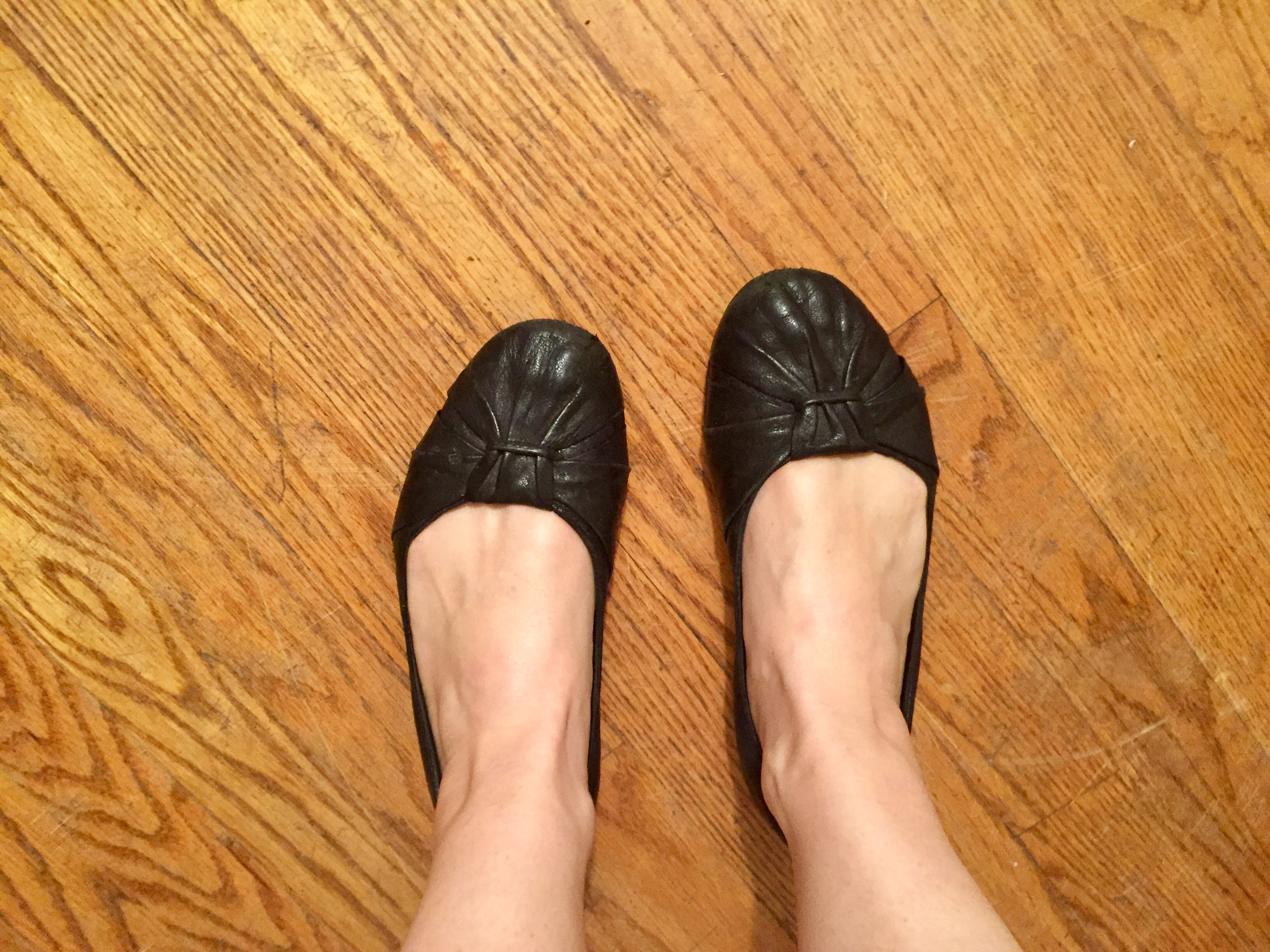
The flats I wore to work today with my LBD, power suit jacket, and pearls.

I am thus thankful to Emma Thompson for her permission to forego heels. Even more importantly, though, her words have needled out the essence of feminism for me: I’m so comfortable now.

Years I’ve spent dismantling patriarchy in my heart and life. I’ve cried. I’ve prayed. I’ve voted. I’ve marched. I’ve talked to my therapist. I’ve created rituals with friends, to honor our sisterhood. I’ve read Adrienne Rich and Audre Lorde and Roberta Bondi and Sue Monk Kidd and many others. It has been good and hard work, and it all comes down to this simple intention, this simple four-word North Star: I’m so comfortable now.

Everything that makes that true, stays. Everything else goes.

Earlier this year, I was getting Maggie, my toddler, ready for preschool. I had brushed her hair and was trying to convince her to wear a small bow clip to keep her hair to the side and out of her eyes. And, let’s be honest, because I think it’s cute. Because I let her wear her hair as she pleased in our family photos last autumn and her wispy blonde bangs going every which way made me afraid that people would think I hadn’t combed her hair. I was afraid of what other people thought.

Finally, I asked Maggie why she wouldn’t wear the bow, and she replied with gusto, “It’s not comfortable!”

There are few prouder moments I’ve had as a mother. I am so grateful to have two daughters as my reminders of the person I want to be. I try to teach them to be true to their selves, and they reflect back to me that law in moments when I forget it.

I hope one day my girls have the opportunity to live in a big city and run to catch buses. Wherever they are, I hope they choose the shoes – and all the things – that make them say to themselves, “I’m so comfortable now.”

*****

PS I am sensitive to the fact that saying that feminism comes down to, “I’m so comfortable now,” could come across like an egregious exercise in privileged white feminism.

I am not comfortable with the threat to their physical safety that women and people of color and members of the LGBTQIA community and nonconformists experience every day.
I am not comfortable with the gender wage gap.
I am not comfortable with harassment and discrimination.
I am not comfortable with a lot of things.
I am not comfortable with the privilege that I experience as a white woman. I am working to be more aware of it and to destroy it.

What “am I comfortable” does for me is challenge me to continue the work of critical, intersectional feminism that asks me every day to be radically accepting of my self and others. In that space of grace and acceptance, I am comfortable.

“If this isn’t nice, what is!”

What I’ve learned, from my earth-loving Unitarian Universalist church in San Diego (“this is our blue boat home”) and my own pantheistic leanings and from Kurt Vonnegut’s Uncle Alex: to wonder to my self, when I experience beautiful things, “If this isn’t nice, what is!

And that’s exactly what I was thinking when I took this picture.